Rick's book · Now in early access
The Architecture of Reasoning
Clear thinking for human decision-making
Read it now on Manning (MEAP)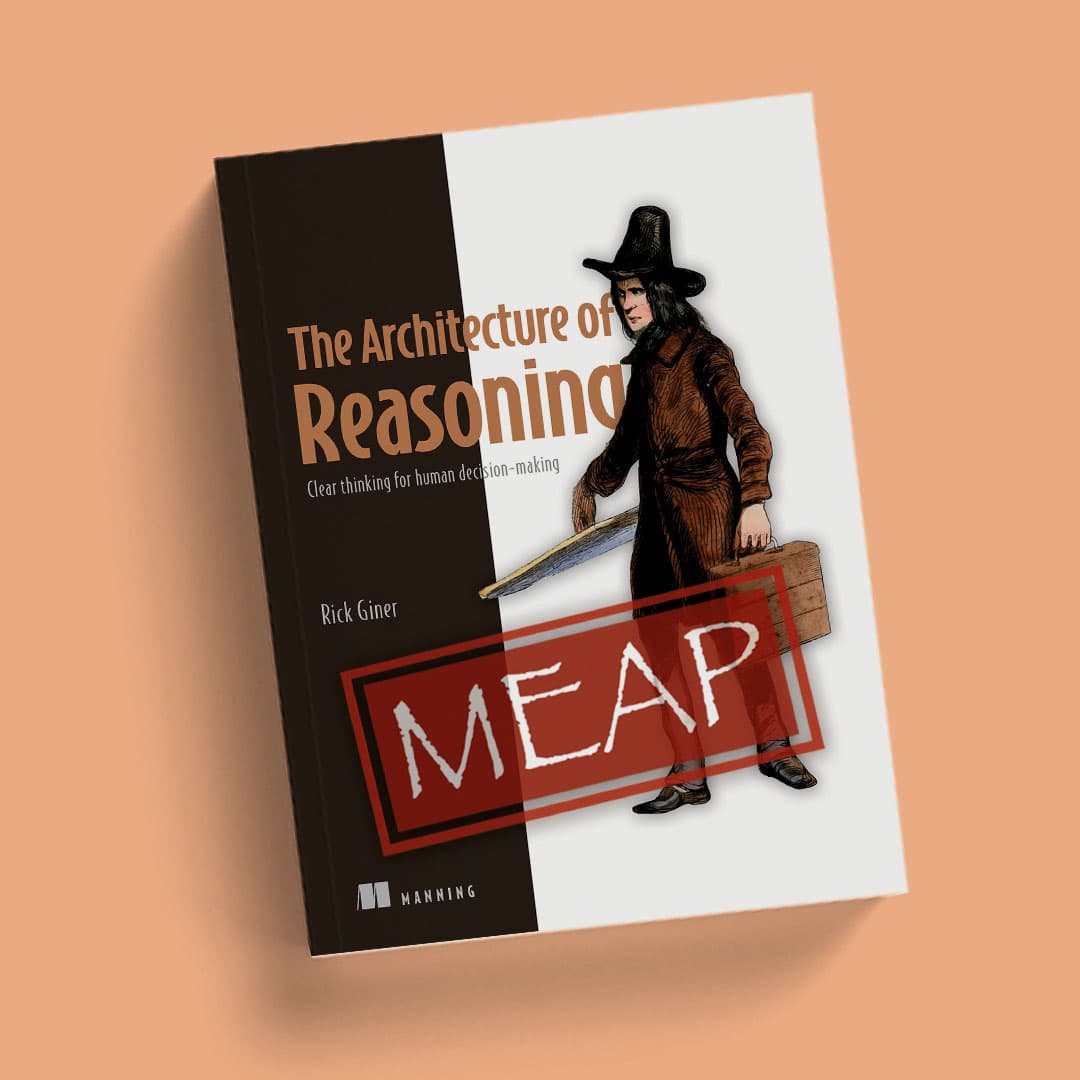
Over the last year I have been writing my first book, The Architecture of Reasoning, now published by Manning and available via their Manning Early Access Program (MEAP).
AI models “reason” by applying repeatable patterns to break down tasks, solve multi-step problems, and produce complex outputs. In the book, I show how those same patterns can improve human decision-making, even when AI is not involved.
The problem is not intelligence
Most teams that make poor decisions are not lacking in intelligence. They are not careless, inexperienced, or poorly motivated. They are full of smart, capable people who genuinely want to do good work.
And yet the same patterns repeat themselves, across industries, across company sizes, across cultures. Priorities shift without explanation. Good ideas stall in committees. Leaders ask for honest input and receive polished consensus. Teams align on a plan and then quietly pull in different directions.
The problem is not intelligence. It is architecture.
What AI revealed
When I started working seriously with large language models, I expected to find a new kind of tool. What I found instead was a mirror.
The way a well-designed prompt produces clear, useful reasoning — and the way a poorly designed one produces confusion, hedging, and hallucination — maps almost perfectly onto the way human teams behave under different structural conditions.
Give a language model ambiguous goals and no constraints, and it drifts. Give it clear context, defined roles, and explicit reasoning steps, and it performs with surprising precision. The model has not changed. Only the architecture around it has.
The same is true of teams.
A new lens for human systems
The Architecture of Reasoning uses the discipline of prompt engineering as a lens for understanding how humans reason, communicate, and decide — individually and together.
This is not a book about AI, though AI is part of the story. It is a book about the hidden structures that shape how we think, how we communicate, and how we make decisions under pressure.
It draws on systems thinking, cognitive science, organisational design, and two and a half decades of working with engineering teams, founders, and leaders across small businesses, agencies, and the public sector.
The dual architecture
The central argument of the book is simple: every organisation has two architectures.
The visible architecture — the org chart, the meeting cadence, the documented processes — is the one that appears in handbooks and onboarding decks.
The invisible architecture — the unspoken assumptions, the patterns of communication, the structural pressures that shape what people say, what they omit, and what they decide — is the one that actually runs the organisation.
Most leadership effort goes into the visible architecture. Most problems live in the invisible one.
The book offers a practical framework for identifying, understanding, and redesigning the invisible architecture — not by overhauling culture in the abstract, but by changing the specific structures and conditions under which reasoning happens.
Why this matters now
We are in a moment of unprecedented complexity. AI is changing the nature of knowledge work. Organisations are being asked to move faster, decide better, and adapt more readily — often with less certainty than before.
In this environment, the quality of your team's reasoning is not a soft concern. It is a strategic one.
The teams that will navigate this moment well are not necessarily the ones with the best technology or the most experienced people. They are the ones who have built the conditions for clear thinking, honest communication, and sound collective judgment.
Five reasoning structures
The book introduces five reasoning structures, and shows when to use each one, how to match the architecture to the problem, and how to avoid using more structure than the task requires:
- Direct Q&A for bounded problems
- Chain-of-Thought for exposing assumptions
- Tree-of-Thought for exploring alternatives
- Chair-of-Thought for rotating perspectives
- ReAct for testing ideas against evidence
What this book gives you
- The ability to recognise reasoning compression, diagnose problem shape, widen the solution space without creating chaos, and turn conclusions into testable hypotheses
- A way to design meetings, documents, reviews, and workflows as reasoning systems that improve decision quality without relying on an expert facilitator
- An understanding of the conditions that make reasoning succeed or fail — attention, status, tempo, evidence quality, and the psychological conditions that shape what teams can see and say
- Compact tools you can apply quickly in real work, such as the 60-second problem-shape check, reasoning-selection tables, and Chain-of-Thought scaffolds
Who this is for
This book is for leaders, founders, and senior practitioners who suspect that the problems in their teams are not people problems — they are system problems.
It is for anyone who has sat in a meeting where the decision made was obviously wrong, and wondered how it happened.
It is for the engineering leader who knows their team is capable of more, but cannot quite put their finger on what is getting in the way.
It is for the founder who has hired well, built something real, and is now watching the organisation slow down as it scales.
The shift
The shift this book is trying to create is not a new methodology or a consulting framework. It is a change in how you see.
Once you can see the invisible architecture — once you understand the structural conditions that produce drift, misalignment, and poor decisions — you cannot unsee it. And once you can see it, you can change it.
That is the work.
Available now in early access
The Architecture of Reasoning is published by Manning and available now through the Manning Early Access Program (MEAP). MEAP readers get chapters as they are written, and the complete ebook when it is finished.
 Read it now on Manning (MEAP)